Frase Review 2026: Is It Still Worth It for Solopreneurs?
The SEO content tool space has gotten crowded. Yet Frase keeps showing up in conversations about what solopreneurs actually use day-to-day — not just what agencies recommend. This Frase review 2026 cuts through the marketing and looks at what the tool actually delivers, where it falls short, and who it makes sense for right now.
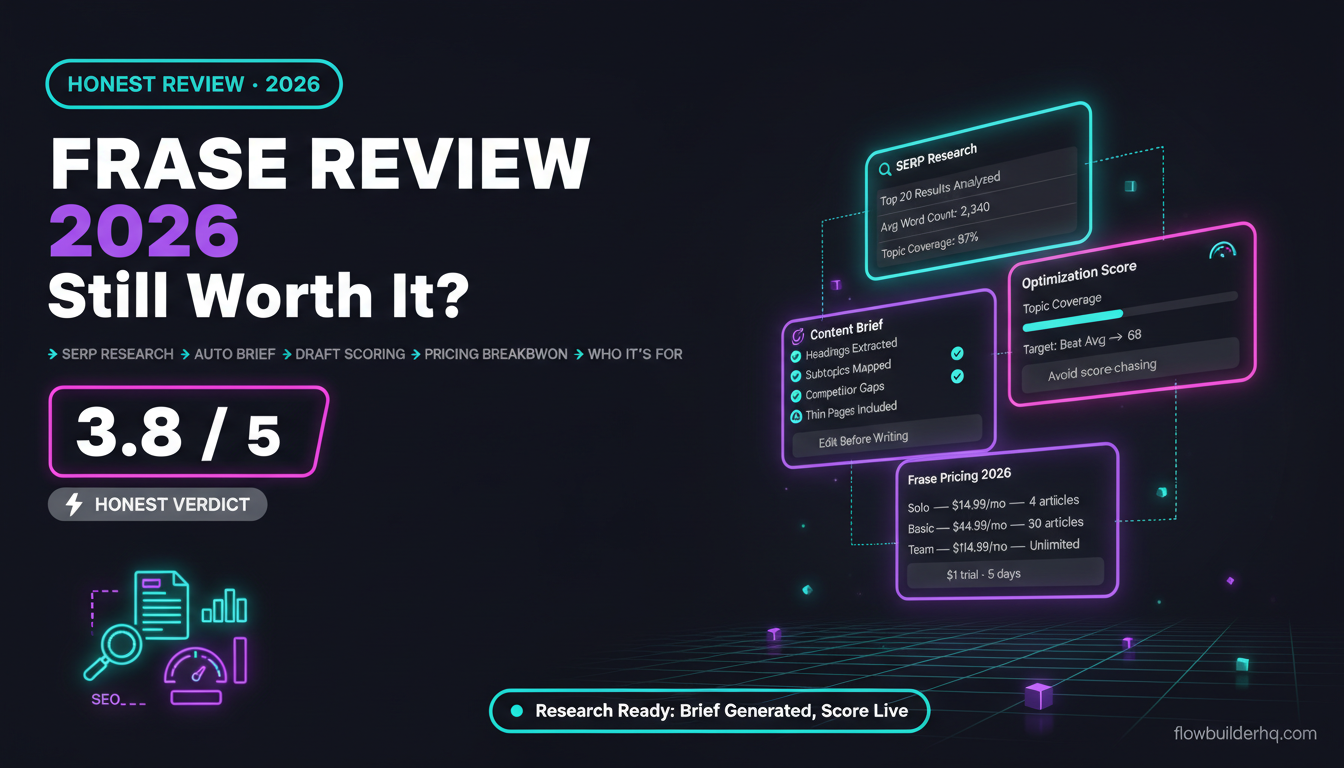
Verdict: 3.8 / 5 — Frase is genuinely useful for research-heavy content workflows, but it’s been outpaced on pure AI writing quality and the pricing model punishes solo operators who need flexibility.
What Frase Actually Does
Frase is an SEO content tool built around one core idea: analyze the top-ranking pages for a keyword, extract what they cover, then help you write something that competes. It combines a SERP research layer with an AI writing assistant in a single editor. You enter a keyword, Frase pulls the top results, builds a content brief automatically, and gives you a score as you write based on how well your article covers the topic compared to those competitors.
That loop — research, brief, write, score — is the whole product. Everything else (AI templates, document management, team workflows) sits around that core. For solopreneurs doing SEO-driven content, that focus is either a strength or a limitation depending on how you work.
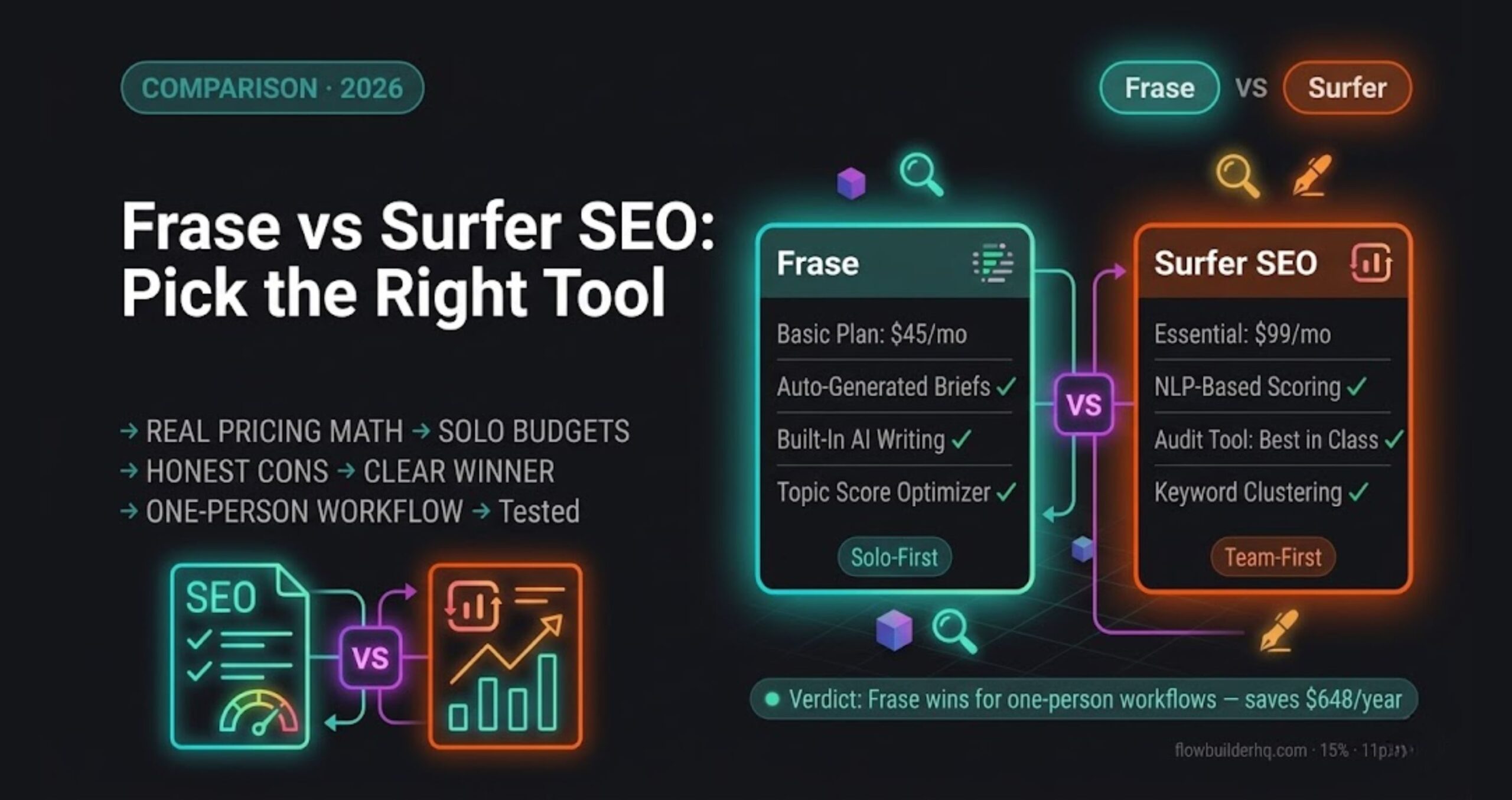
If you’re comparing it head-to-head against its main competition, our breakdown of Frase vs Surfer SEO for solopreneurs goes deeper on where each tool actually wins.
Frase Pricing in 2026
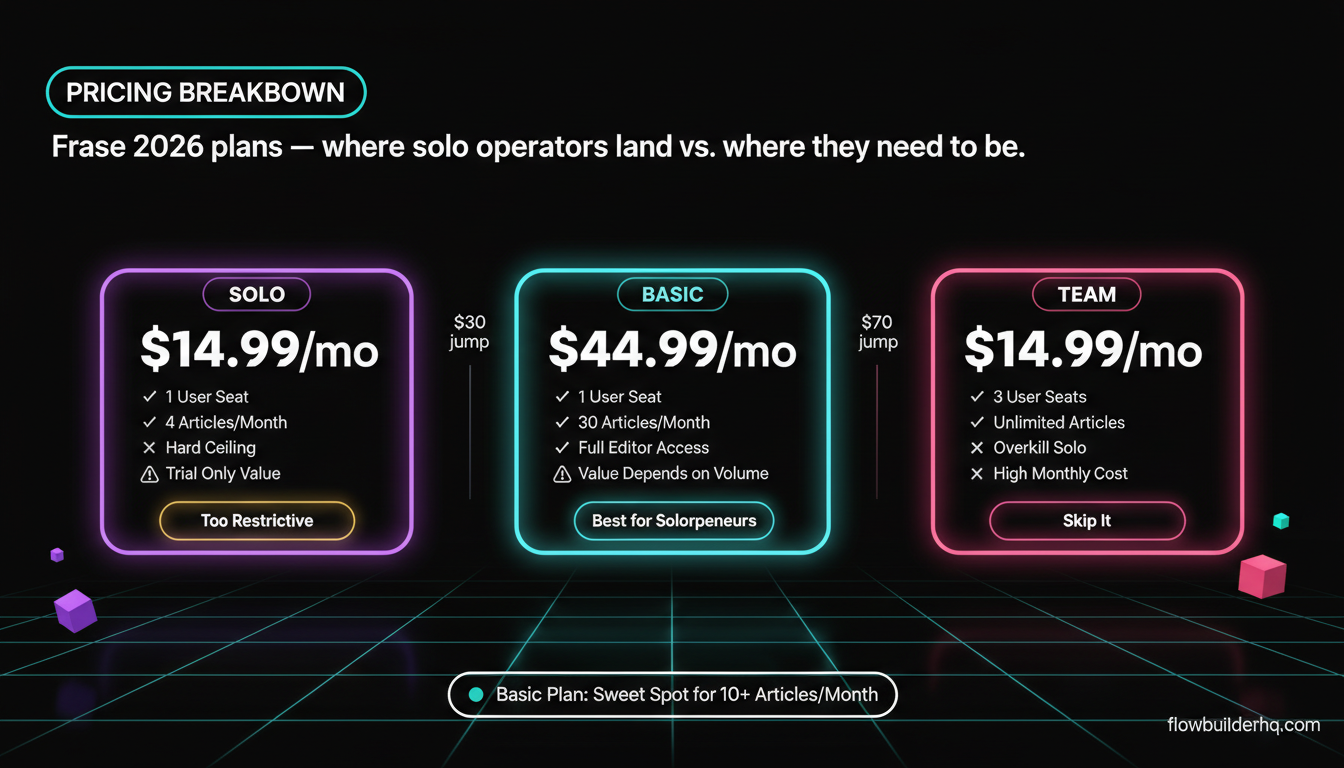
Frase currently runs three plans:
- Solo: $14.99/month — 1 user seat, 4 articles per month
- Basic: $44.99/month — 1 user seat, 30 articles per month
- Team: $114.99/month — 3 user seats, unlimited articles
The Solo plan sounds appealing until you realize four articles per month is a hard ceiling. If you publish weekly, you’re already over it. Most solopreneurs doing any real content volume land on the Basic plan at $44.99/month, which is where the value calculation gets complicated.
There’s no free plan — only a five-day trial for $1. That trial is enough time to run a few real queries and get a feel for the workflow, which is the right move before committing.
Frase Review 2026: The Honest Test Scenarios
SERP Research and Brief Generation
This is where Frase earns its keep. Run a keyword query and within about 30 seconds you get a breakdown of the top 20 organic results — average word count, domain authority, heading structure, and a list of topics each competitor covers. Frase then compiles those topics into a content brief you can edit before writing.
The brief quality is solid. It’s not perfect — it occasionally lumps unrelated subtopics together or over-weights thin competitor pages — but as a starting framework it saves real time versus doing manual SERP research. For solopreneurs who write their own content but don’t want to spend an hour pulling apart competitor articles, this is the primary value proposition.
The roundup of AI writing tools for solopreneurs on this site covers how Frase’s research layer compares to tools focused purely on generation — worth reading if you’re trying to figure out which category of tool fits your workflow.
The Content Editor and Optimization Score
While writing, Frase shows a topic coverage score in real time. As you mention concepts from the brief, your score climbs. The target score is based on what competitors average. Hit above average and you’re in good shape.
This works well for factual, research-backed content. It works less well when your content strategy intentionally diverges from what’s already ranking — if you’re writing an original opinion piece or a case study, optimizing for a score built on competitor averages creates bad incentives. You end up adding sentences that serve the score, not the reader.
That’s a known limitation of any topic-cluster scoring approach. Frase didn’t invent this problem, but it’s worth knowing before you commit to the workflow.
AI Writing Quality
Frase’s AI writing output is functional but not impressive. It generates paragraphs from your brief headings, expands bullet points, and can draft full sections on request. The output is grammatically clean and topically relevant, but it has a flatness to it — the kind of serviceable prose that needs significant editing before it sounds like a real person wrote it.
Tools like Claude produce noticeably better first-draft prose. If you’re curious how AI fits into a broader content and automation stack, the guide on using Claude AI for business automation has practical context for solopreneurs thinking about this layer.
Frase’s AI writing is best understood as a research-to-draft bridge. It gets you from a structured brief to a rough draft faster than starting from a blank page. Expecting it to produce publish-ready content is setting yourself up for disappointment.
Document Management
Frase stores all your research documents in a dashboard. You can organize by project or client. The interface is clean and search works fine. There’s nothing wrong here, but there’s also nothing notable — it’s a document list, not a CMS or production system.
If you need a real content production workflow with status tracking, assignments, and publishing integration, Frase won’t replace that. Pair it with something like Notion or Airtable for project management. Airtable’s Team plan runs $20/seat/month if you want a comparison point.
3 Real Cons — Not Softened
1. The Article Limit on the Entry Plan Is Too Low
Four articles per month on the Solo plan is not a content strategy — it’s a test drive. Any solopreneur publishing consistently enough to build organic traffic will immediately need the Basic plan. That $30 jump from $14.99 to $44.99 is steep when comparable SERP research can be done manually or with cheaper tooling. Frase loses the value argument at the Basic price point for users who aren’t extracting full value from the AI writing layer.
2. AI Output Needs Heavy Editing
The AI writing is not a finished product. It’s a draft accelerator. If you’re buying Frase expecting to cut your writing time by 80%, you’ll be disappointed. Expect 30-40% faster drafting if you edit the output properly, not a shortcut to skip writing altogether.
3. No Native Automation or Integration Hooks
Frase has no native webhook support and no Make.com or Zapier native integration. You can’t trigger a Frase document creation from a form submission or push a completed brief into a project management tool automatically. For solopreneurs building automated content workflows, this is a friction point. You can work around it with browser automation or API workarounds, but it’s not clean.
If automation is central to how you produce content, tools that integrate with your stack matter. The best no-code automation tools for 2026 covers the automation layer separately — worth reading alongside any content tool review.
Who Frase Is For
Frase makes the most sense for solopreneurs who:
- Write 10+ SEO articles per month and want to cut research time
- Are on the Basic plan and fully using the article volume
- Treat the AI output as a first draft they’ll substantially edit
- Work primarily in English (non-English SERP data is patchier)
- Already have a content strategy and need execution help, not strategy help
Who Frase Is NOT For
- Solopreneurs publishing fewer than 4 articles per month — the pricing doesn’t justify it
- Anyone expecting publish-ready AI output without heavy editing
- Operators who need automation hooks to connect their content workflow to their CRM, email platform, or project tools
- Non-English content creators who rely on accurate local SERP data
- Creators focused on social content, newsletters, or formats outside long-form SEO articles
Frase vs. the Alternatives
The two tools most often compared to Frase are Surfer SEO and Copy.ai — though they solve adjacent problems rather than identical ones.
Surfer is more granular on technical SEO scoring. It tracks keyword density, NLP terms, and structural signals with more precision than Frase’s topic-coverage model. Surfer’s pricing is higher, which tips the value calculation depending on your content volume and how much you trust keyword-density optimization signals. Full take on that in the Frase vs Surfer comparison.
Copy.ai sits on the opposite end — pure AI writing with minimal SERP research tooling. Its Starter plan runs $49/month ($36/month on annual). It’s the better pick if writing speed matters more than research depth. The Copy.ai review on this site covers its strengths and where it falls short for solo operators.
For the automation-first operator, neither Frase nor Copy.ai connects natively into the kind of multi-step workflows that tools like Make.com enable. If you want content research to automatically trigger brief creation, draft generation, and a Slack or email notification — you’re building that connector yourself. Make.com’s Pro plan at $16/month is often the glue layer for operators running those kinds of stacks.
Current Pricing Summary
| Plan | Price | Articles/Month | Users |
|---|---|---|---|
| Solo | $14.99/mo | 4 | 1 |
| Basic | $44.99/mo | 30 | 1 |
| Team | $114.99/mo | Unlimited | 3 |
Annual pricing reduces these costs, but Frase doesn’t publish the annual discount prominently — check Frase’s current pricing page directly for the latest numbers before committing.
The Bottom Line on This Frase Review 2026
Frase is a solid research tool with a decent editor bolted on. The SERP analysis and auto-generated briefs are genuinely useful and save real time for solopreneurs doing volume SEO content. The AI writing layer is a draft aid, not a draft replacement. The pricing model makes most sense at the Basic plan for high-volume publishers — anyone publishing less frequently is overpaying relative to alternatives.
If SEO content is your primary traffic channel and you publish consistently at volume, Frase earns its place in the stack. If you’re still figuring out your content workflow or publish sporadically, the money is better spent elsewhere first — either on a stronger AI writing tool or on building the automation layer that makes consistent publishing feasible.
For operators thinking about the broader content production stack — how content tools connect to email, CRM, and publishing workflows — the best automation tools for solopreneurs in 2026 is a good next read. And if email follow-up after content-driven lead capture is the next piece you’re building, the guide on automating email follow-ups with Make.com walks through a real workflow.
Building this yourself? Get the workflow pack.
5 ready-to-import n8n workflows — lead capture, invoicing, content repurposing, onboarding, social posting. Free.