HubSpot Free vs Paid: Is the Upgrade Worth It for Solopreneurs?
The HubSpot free vs paid decision hits every solopreneur eventually. You’ve been on HubSpot Free for 60 days. Contacts are in. A few deals are moving. Then you hit a wall — an email sequence you can’t automate, a report you can’t pull, a feature locked behind a plan that costs more per month than most solopreneurs spend on software combined. Now you’re asking: is the paid upgrade actually worth it, or is this the moment to look elsewhere?
That’s the exact question this post answers. Not from a corporate team with a $2,000/month budget, but from a one-person operation where every tool has to justify itself.
The Short Answer
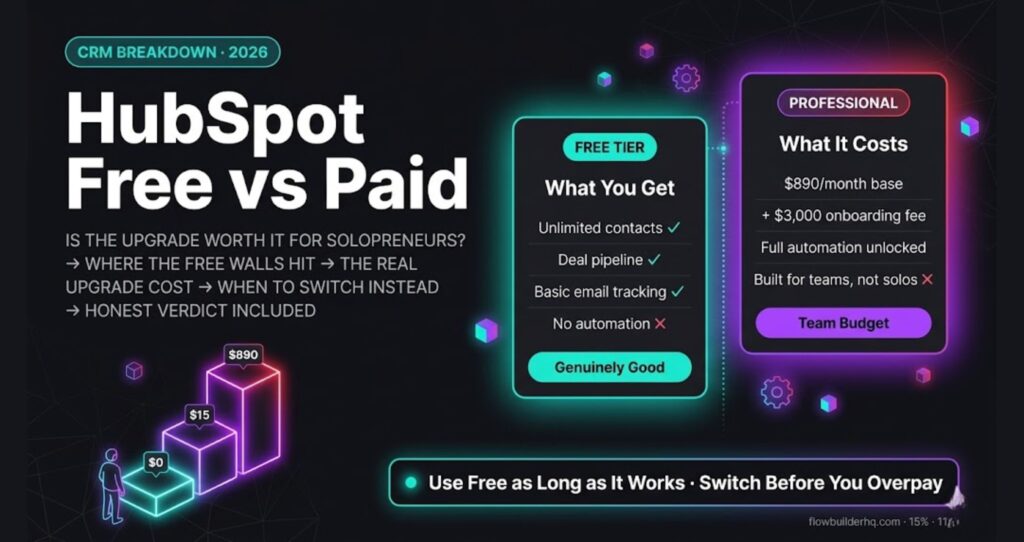
HubSpot Free is genuinely one of the best free CRMs available. For contact management, deal tracking, and basic email, it holds up longer than most. But the paid tiers — Starter, Professional, Enterprise — are priced for teams, not solopreneurs. The jump from free to Starter is $15–$20/month per seat. The jump to Professional (where the real automation lives) is $890/month — and that’s before a one-time $3,000 onboarding fee HubSpot requires on Marketing Hub Professional. That number is not a typo.
For most solopreneurs, the honest answer is: use the free tier as long as it works, then switch tools rather than upgrade. But the calculation depends on exactly which walls you’re hitting. Let’s go through them.
What HubSpot Free Actually Gives You
HubSpot’s free CRM is more generous than its competitors at the zero-dollar tier. Here’s what you actually get:
- Unlimited contacts — no contact cap on the free plan
- Deal pipeline — one pipeline, up to a point
- Contact and company records — solid, with activity logging
- Gmail and Outlook integration — email tracking, open notifications
- Meeting scheduler — one personal link
- Forms and landing pages — basic, with HubSpot branding
- Live chat and chatbot — limited but functional
- 2,000 marketing email sends/month — enough for a small list
- Basic reporting — canned dashboards, no custom reports
For a solopreneur just getting started with CRM discipline — logging client conversations, tracking where deals are, booking calls — this is real value. You can run a lean client pipeline on free HubSpot for months without needing more.
Where the Free Tier Wall Hits
This is where most evaluations go vague. Here are the specific walls, in the order most solopreneurs hit them:
1. Email Automation
HubSpot Free includes no automated email sequences. You can send one-off emails and track opens, but you cannot set up a drip sequence, a welcome automation, or a follow-up workflow triggered by contact behavior. That functionality starts at Marketing Hub Starter — and even there, it’s limited. Full workflow automation (branching logic, multi-step sequences based on CRM data) requires Marketing Hub Professional at $890/month.
For solopreneurs, this is usually the first hard stop.
2. Reporting and Custom Dashboards
Free reporting is locked to pre-built dashboards. You cannot create custom reports, filter by custom properties in reports, or build a revenue attribution view. Custom reporting requires Professional tier.
3. Removing HubSpot Branding
Every form, landing page, email, and chatbot on the free plan shows HubSpot branding. Removing it requires a paid upgrade. For client-facing assets, this matters.
4. Multiple Pipelines
Free gives you one deal pipeline. If you track different service lines, project types, or client stages separately, you need Starter ($15–$20/seat/month) for additional pipelines.
5. Sequences (Sales Automation)
HubSpot’s Sequences tool — which lets you enroll contacts in automated email + task cadences from the CRM — is locked behind Sales Hub Professional at $100/seat/month. Not Starter. Professional. This surprises a lot of people who assume basic sales automation comes with any paid plan.
6. A/B Testing
No A/B testing on emails or landing pages below Professional tier.
7. Contact Limits on Marketing Emails
The free plan limits marketing email sends to 2,000/month. If your list grows past a few hundred contacts with regular sends, you’ll hit this fast. Increasing it means upgrading.
HubSpot Pricing: The Real Numbers for Solopreneurs
| Plan | Monthly Cost | Key Unlock | Solopreneur Verdict |
|---|---|---|---|
| Free | $0 | CRM, basic email, 1 pipeline | Use it. Strong for the price. |
| Starter (Marketing) | $15–$20/mo | More sends, remove branding, basic automation | Marginal. Automation still weak. |
| Starter (Sales) | $15–$20/seat/mo | More pipelines, calling | Reasonable if you need multiple pipelines. |
| Professional (Marketing) | $890/mo | Full workflows, A/B testing, custom reports | Not for solopreneurs. Period. |
| Professional (Sales) | $100/seat/mo | Sequences, forecasting | Only if email cadences are core to your business. |
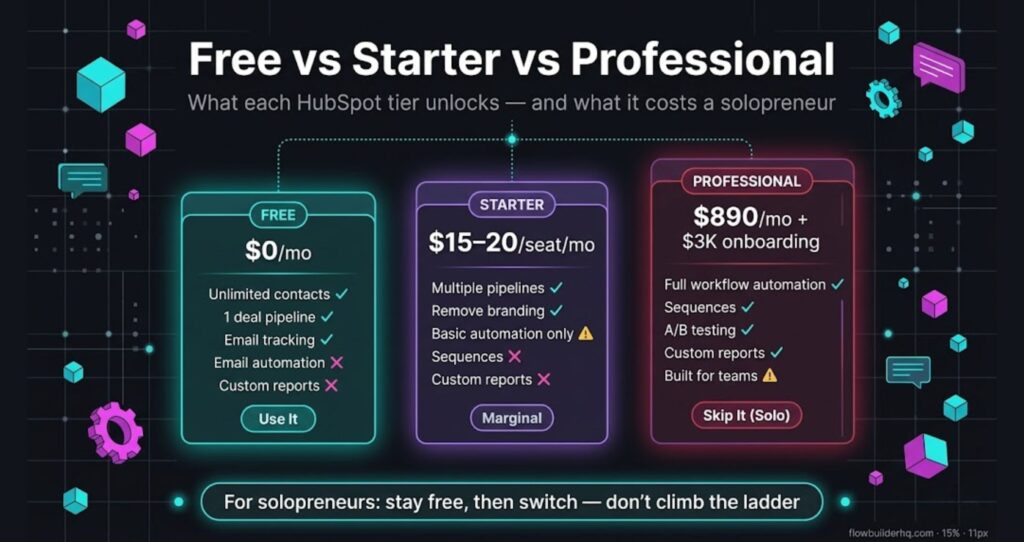
The pricing structure exposes the fundamental problem: HubSpot is architected for teams. The features solopreneurs actually want — full automation, sequences, advanced reporting — sit behind price points designed for 5–20 person sales and marketing teams with matching budgets.
When the Upgrade Makes Sense for a Solopreneur
There are specific situations where upgrading does pencil out:
- You run a high-ticket service business and closing one extra deal per month covers the cost of Sales Hub Professional. If each client is worth $5,000+, the math can work.
- You want everything in one place and the consolidation value (replacing 3–4 separate tools) justifies the cost. HubSpot Free + Starter can replace a separate meeting tool, form builder, basic email platform, and CRM.
- You’re preparing to hand off systems to a VA or small team. HubSpot’s interface is easy to train on. If you’re scaling toward a 2–5 person operation, locking in HubSpot now has logic.
- You need Sales Hub Starter specifically for multiple pipelines. At $15–$20/month, this is the one paid tier with a reasonable solopreneur use case.
When to Switch Instead of Upgrade
If your primary pain point is email automation — which is the case for most solopreneurs who outgrow the free plan — the upgrade math doesn’t work. Marketing Hub Professional at $890/month is the tier where automation gets real, and that price is unjustifiable for a one-person operation.
The better move is to keep HubSpot Free as your CRM (it’s still good for contact and deal management) and pair it with a purpose-built email automation tool. Or, switch your core operations to a platform priced for solopreneurs from the start.
ActiveCampaign is the most direct alternative here. Its Starter plan begins at $15/month for up to 1,000 contacts, with the Plus plan at $49/month adding the deeper automation most solopreneurs want — trigger-based sequences, conditional logic, multi-step workflows. The automation that costs $890/month in HubSpot costs a fraction of that in ActiveCampaign.The CRM capabilities are lighter, but for solopreneurs where email nurture is the core workflow, that tradeoff is usually worth it. (Note: affiliate link pending approval — check back for updated link.)
(A full ActiveCampaign vs MailerLite breakdown is coming — check back or subscribe to get notified when it’s live.)
HubSpot Free vs Paid: Feature Comparison
| Feature | Free | Starter | Professional |
|---|---|---|---|
| Contact management | ✓ Unlimited | ✓ | ✓ |
| Deal pipelines | 1 | Multiple | Multiple |
| Marketing email sends | 2,000/mo | 5x contact tier | 10x contact tier |
| Email automation workflows | ✗ | Limited | Full |
| Sales sequences | ✗ | ✗ | ✓ (Sales Pro) |
| Custom reports | ✗ | ✗ | ✓ |
| A/B testing | ✗ | ✗ | ✓ |
| Remove HubSpot branding | ✗ | ✓ | ✓ |
| Meeting scheduler | 1 link | Multiple | Multiple |
| Monthly cost (solo) | $0 | $15–$20 | $890+ (Marketing) |
The Honest Cons of HubSpot (Even the Free Tier)
Even if you stay on free, HubSpot has real friction points worth knowing:
- Interface bloat: HubSpot is built for teams and shows it. The sidebar navigation, the constant upsell prompts, the greyed-out features you can’t use — it adds cognitive load for a solopreneur who just wants to check on three deals.
- Email deliverability on free: Sending marketing emails from a shared HubSpot domain (before you connect your own) can affect deliverability. Connecting a custom sending domain requires configuration and is not instant.
- Data portability friction: Getting your data cleanly out of HubSpot when you decide to move isn’t hard, but the export process for contacts with all associated properties and activity history takes planning.
- The upsell pressure is constant: Every locked feature has a bright orange upgrade button. This is by design, but for solopreneurs evaluating tools, it distorts your perception of what you’re actually getting vs. being sold.
Recommended Setup for Solopreneurs in 2026
Based on where the free-tier walls sit and where the paid tiers price out, here’s the setup that makes the most sense for most solopreneurs:
Option A — Stay Free, Add Automation Separately: Keep HubSpot Free for CRM and deal tracking. Add ActiveCampaign (Lite, $15/month) for email automation. Use a lightweight automation stack to connect them if needed. Total cost: $15/month for a capable system.
Option B — All-in on a Solopreneur-Priced CRM: If HubSpot’s interface friction is slowing you down or you want email + CRM unified without the HubSpot pricing ladder, evaluate alternatives purpose-built for small operators. See our roundup of the Best Automation Tools for Solopreneurs in 2026 for a full breakdown.
Option C — HubSpot Starter (Sales Hub only): If multiple pipelines are your only pain point and you’re managing $10K+/month in services, Sales Hub Starter at $15–$20/month is defensible. Don’t upgrade Marketing Hub to Starter — the automation unlock is too weak to justify even that cost.
Final Verdict
HubSpot Free: Use it. It’s the best free CRM tier available for solopreneurs who need contact management, basic deal tracking, and light email. Run it until you hit the walls described above.
HubSpot Starter: Marginal. The only Starter upgrade that makes sense for solopreneurs is Sales Hub Starter for multiple pipelines. Marketing Hub Starter’s automation is too limited to solve the core problem.
HubSpot Professional: Skip it. $890/month is a team budget. If you’re a solopreneur and you’ve hit the automation wall, switch tools — don’t upgrade to Professional.
The free tier is a legitimate tool. The paid upgrade is a legitimate product — just not for solopreneurs. Knowing the difference saves you from a decision that looks like a logical next step but is actually a pricing trap built for a different customer.
Building this yourself? Get the workflow pack.
5 ready-to-import n8n workflows — lead capture, invoicing, content repurposing, onboarding, social posting. Free.