Writesonic Review for Solopreneurs: Honest Take After Using It for Content
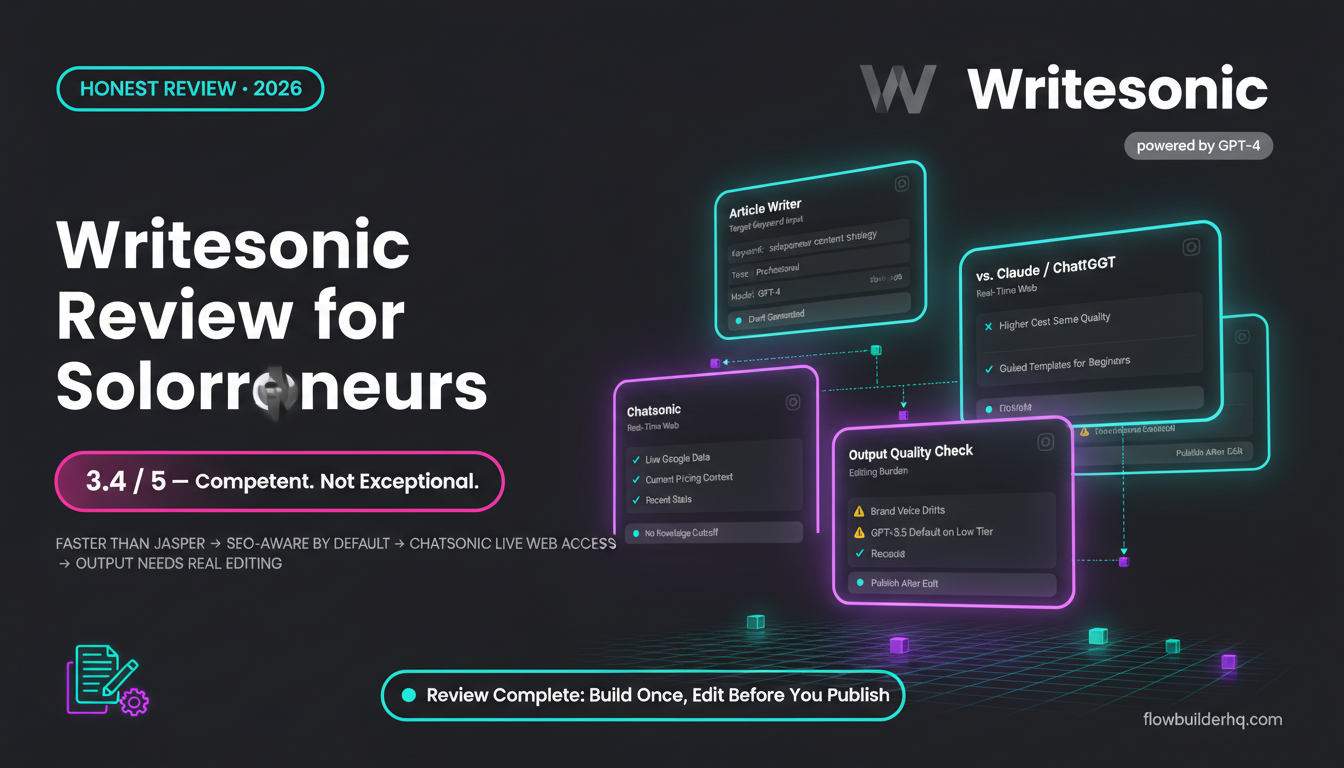
Rating: 3.4 / 5
Writesonic sits in a crowded corner of the AI writing tool market, competing directly with Jasper and Copy.ai while also running up against free-tier tools like ChatGPT and Claude. This Writesonic review for solopreneurs cuts through the marketing noise: what it actually does, where it earns its price tag, and where it doesn’t hold up compared to tools you might already be using.
The short version: Writesonic is faster to onboard than Jasper, cheaper than Jasper at most tiers, and more SEO-aware than Copy.ai out of the box. But it’s not the best pure writer in the room, and if you’re already comfortable prompting Claude or ChatGPT directly, you’ll feel the ceiling fast.
If you’re evaluating the full landscape of AI writing tools, our roundup of best AI writing tools for solopreneurs in 2026 covers the broader comparison. This post focuses specifically on Writesonic.
What Writesonic Actually Is
Writesonic is a multi-format AI writing platform built primarily around GPT-4 and its own fine-tuned models. The core product covers blog posts, landing pages, ad copy, product descriptions, and social content. It also ships with Chatsonic — its own ChatGPT-style interface — and Botsonic, a chatbot builder layered on top.
The platform has grown feature-heavy over the past couple of years. That’s both good and bad. The good: it covers a wide surface area for content production. The bad: the UI is noticeably busier than it needs to be, and you’ll spend time figuring out which of the 80+ templates actually applies to your workflow.
For the purposes of this review, the focus is on what solopreneurs realistically use: long-form article generation, product/service page copy, and short-form social and email content.
Current Writesonic Pricing (2026)
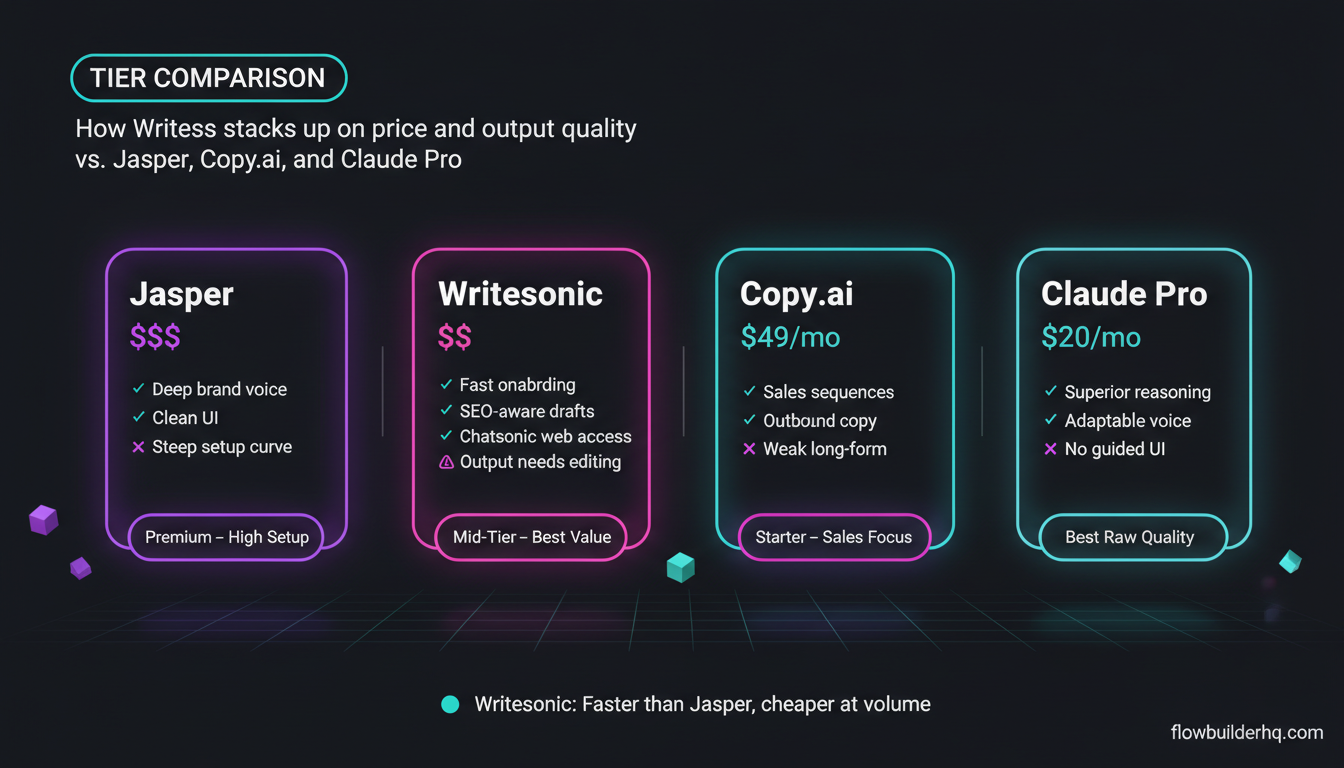
Writesonic’s pricing structure has shifted several times, so check current pricing directly on their site before committing. At the time of writing, they offer a free trial (limited words), an Individual plan, and higher-tier Team plans. Pricing varies based on word count, model quality tier, and seat count. It’s not the cleanest pricing structure to parse — which is a minor frustration when you just want to know what you’ll pay monthly.
For comparison context: Copy.ai’s Starter plan runs $49/month ($36/month on annual), and Jasper starts higher. Writesonic generally positions between those two on price, which puts it in reasonable territory for solopreneurs who need volume output rather than premium reasoning.
What Writesonic Does Better Than Jasper
Having looked at both tools closely — and our full Jasper AI review for solopreneurs goes deep on Jasper’s limitations — there are a few areas where Writesonic genuinely wins.
Onboarding speed
Jasper has a steep setup curve. You’re expected to configure brand voices, tone documents, and knowledge bases before the output feels usable. Writesonic gets you to a first draft faster. Pick a template, drop in a topic, get output. That matters when you’re a one-person shop trying to ship content, not configure software.
Built-in SEO awareness
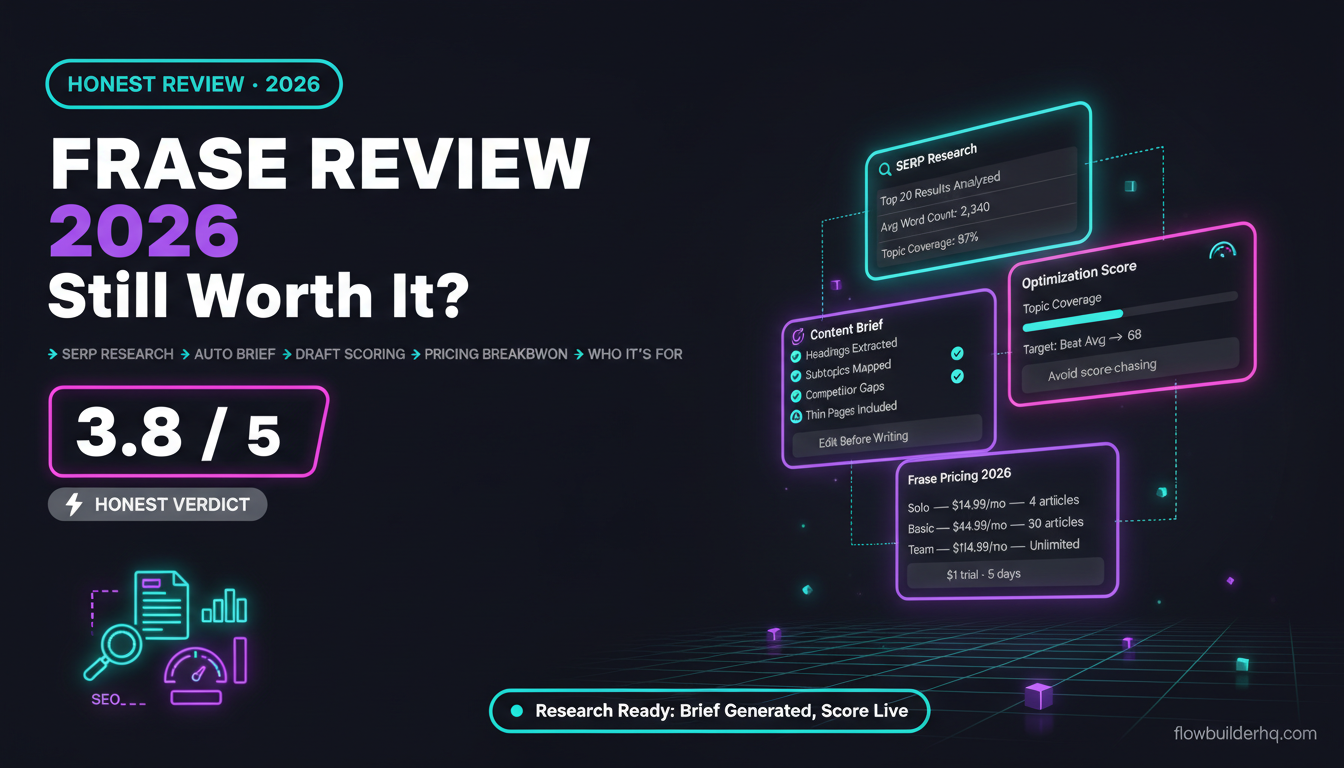
Writesonic’s Article Writer (particularly the newer versions) will ask for a target keyword and attempt to structure content around it. It’s not a replacement for a dedicated SEO content tool — if you want that, our Frase review and the Frase vs Surfer SEO comparison are better references — but the awareness is baked in at the generation stage rather than bolted on afterward like it is with Jasper.
Chatsonic is actually useful
Chatsonic differentiates from standard ChatGPT by connecting to real-time web data (Google Search integration). For solopreneurs writing content that needs current stats, recent events, or updated pricing context, this is genuinely handy. You’re not prompting from a knowledge cutoff; you’re pulling live context. It’s not flawless, but it works often enough to be worth using.
Template breadth
80+ templates sounds like bloat — and honestly some of it is — but for solopreneurs who produce a wide variety of content types (blog, LinkedIn, email, product page), having everything in one dashboard without switching tools has real value.
Where Writesonic Falls Short
This is the section that matters most for a buying decision.
Output quality ceiling
Writesonic’s generated content is competent but rarely impressive. It produces grammatically clean, logically structured drafts that need editing before publishing. The problem is the editing burden. If you’re spending 30-40 minutes rewriting a 1,500-word article that took 2 minutes to generate, the productivity math only works if you’re using it as a structural scaffold — not as finished copy.
Compare that to prompting Claude directly with a detailed prompt: the output quality is noticeably higher, the writing voice is more adaptable, and there’s no template overhead. Claude doesn’t have a content-specific UI, but for solopreneurs comfortable writing good prompts, raw Claude or ChatGPT will often produce a better first draft than Writesonic’s templated workflow.
If you want a head-to-head on those tools, the ChatGPT vs Claude comparison for solopreneur tasks is worth reading alongside this review.
Brand voice consistency
Writesonic has a brand voice feature, but it’s shallow compared to what Jasper offers with its documented brand voice system. Across multiple generations in a session, tone drift is noticeable. If you’re producing content at volume and need it to sound like you wrote it all, you’ll still need a heavy editing pass.
The free tier is genuinely limited
The trial gives you enough to test the interface but not enough to evaluate long-form output quality at scale. A few hundred words of trial output won’t tell you whether the tool works for your specific content workflow. That’s a frustration when you’re trying to make a real buying decision.
Model selection confusion
Writesonic lets you choose between GPT-3.5 and GPT-4 (and occasionally its own fine-tuned models), but the quality differences aren’t clearly communicated, and cheaper word count plans default to lower-quality models. You can burn through a word plan on GPT-3.5 outputs and wonder why the quality is inconsistent — only to discover you need to upgrade to access GPT-4 generation for every template. That’s a user experience problem worth flagging.
Cluttered interface
The dashboard is genuinely cluttered. Botsonic, Chatsonic, the Article Writer, individual templates, and a landing page builder all compete for your attention. If you just want to write a blog post, finding the right entry point takes more clicks than it should. Jasper’s interface is cleaner despite having comparable feature depth.
Writesonic vs Copy.ai
Copy.ai positions itself more aggressively as a go-to-market content tool — pipelines, sales sequences, and outbound copy are its strong suit. Writesonic positions as a broader content platform with SEO-adjacent features.
For solopreneurs doing primarily long-form content and blog production, Writesonic has the edge over Copy.ai. For solopreneurs who need email sequences, sales copy, and short-form output primarily, Copy.ai competes harder. Our Copy.ai review has the full breakdown if you’re deciding between them.
Writesonic vs Claude / ChatGPT
This is the honest comparison that most Writesonic reviews avoid. Claude and ChatGPT are free at their base tiers. Claude Pro and ChatGPT Plus each run $20/month. For that price, you get significantly better reasoning, better writing quality, and unlimited flexibility in how you prompt.
What Writesonic offers over raw LLMs is structure: templates, guided inputs, and a workflow that non-prompt-savvy users can follow without thinking. The SEO-keyword awareness and the Chatsonic real-time web access are also genuine additions that raw Claude doesn’t match without extensions or plugins.
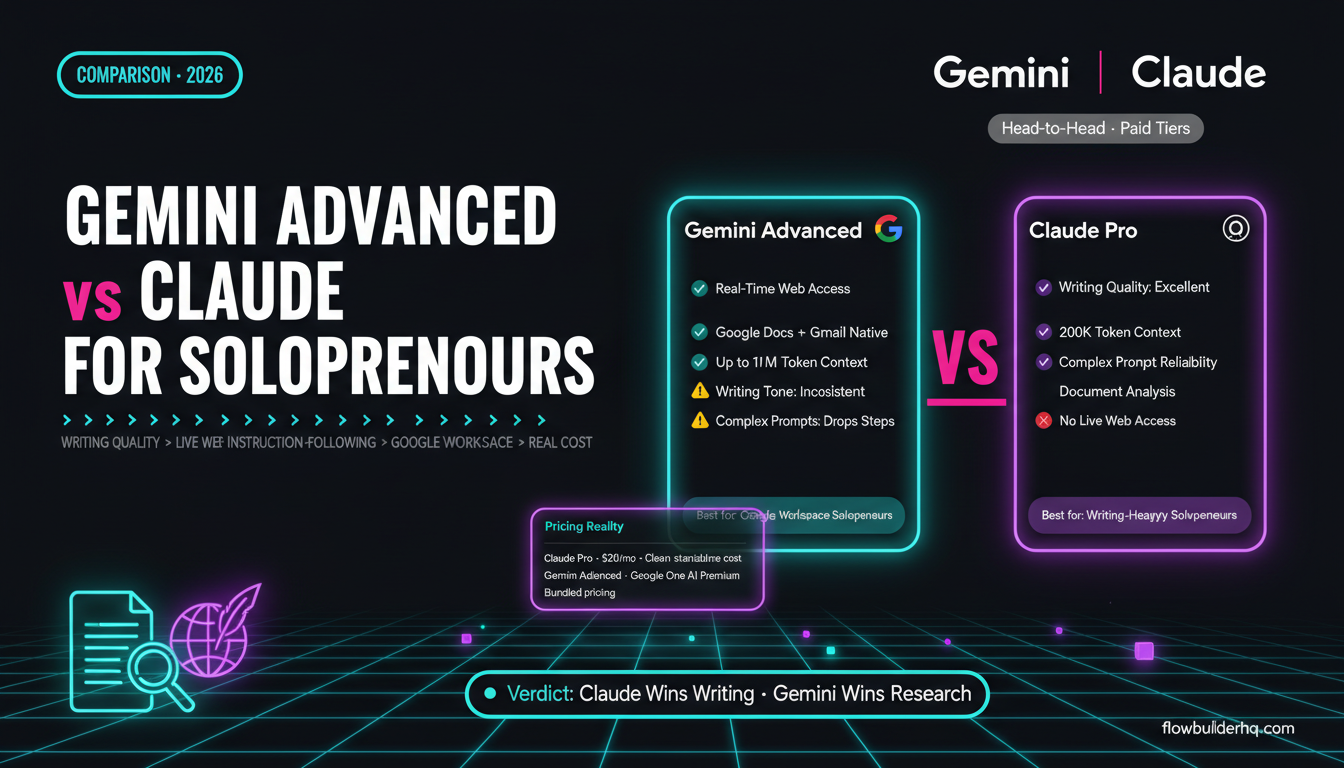
But if you’ve already built a content workflow around prompting Claude with a well-structured system prompt — as covered in the Gemini vs Claude comparison for solopreneur writing — Writesonic won’t make you faster or produce better output. It’ll add a layer of UI between you and the model.
For solopreneurs who haven’t built that prompting fluency yet, Writesonic’s guided structure genuinely helps. That’s its real market: capable but non-technical writers who want AI assistance without having to engineer prompts from scratch.
Honest Cons Summary
- Output needs real editing — don’t expect publish-ready copy without a substantive pass
- Brand voice doesn’t hold across multiple generations in a session
- Model tier confusion — cheaper plans default to lower-quality outputs without clear labeling
- Interface is cluttered — feature sprawl makes simple tasks take extra clicks
- Pricing structure is opaque — word count tiers and model tiers interact in ways that aren’t obvious upfront
- Free trial is too limited to evaluate long-form quality before buying
Who Writesonic Is Actually For
Writesonic works best for solopreneurs who:
- Produce high volume content (multiple blog posts or pages per week)
- Aren’t confident building detailed prompts from scratch
- Want SEO-aware first drafts without a separate SEO content tool subscription
- Are scaling a content-heavy business and need scaffold-level drafts, not final copy
- Value Chatsonic’s real-time web access for research-adjacent content
Who Should Skip It
- Solopreneurs already comfortable prompting Claude or ChatGPT directly — you’ll hit the ceiling fast and pay for features you don’t use
- Anyone who needs highly consistent brand voice at scale — Jasper’s brand voice system is more developed
- Solopreneurs primarily doing sales copy and outbound sequences — Copy.ai is sharper there
- Anyone on a tight budget who only needs occasional content help — Claude’s free tier handles that
If you’re looking at the broader picture of what your solo tech stack should look like, the solopreneur tech stack breakdown for 2026 puts AI writing tools in context alongside automation, CRM, and other critical tools. And if you’re thinking about AI tools more broadly rather than just writing specifically, the AI tools for solopreneur productivity in 2026 covers the full landscape of what’s actually worth paying for.
Writesonic also pairs naturally with content automation workflows. If you want to push generated drafts automatically into a CMS or Google Doc via trigger, that’s a job for a no-code tool. Our guide on automating your content publishing workflow with Make.com shows how to connect the output side of an AI writing process to the distribution side.
Final Verdict
Writesonic is a competent, mid-tier AI writing tool. It’s faster to onboard than Jasper, more SEO-aware than Copy.ai out of the box, and cheaper than either at comparable output volumes. Chatsonic’s real-time web access is a legitimate differentiator. The Article Writer produces usable scaffolds for blog content.
But “competent” and “cheaper” are not the same as “the right tool.” If you’re already using Claude or ChatGPT with well-crafted prompts, Writesonic won’t improve your output — it’ll just add structure you don’t need. If you’re new to AI-assisted writing and want guardrails, it earns its price. If you need top-tier writing quality, build your prompting skill with Claude instead. The Claude API guide for solopreneurs is a good starting point if you want to go that route.
For a tool-agnostic look at how AI writing fits into a broader content production system, Anthropic’s published research on language model capabilities gives useful grounding on what these tools actually do well — and OpenAI’s GPT-4 technical overview explains the model Writesonic’s higher tiers run on.
Rating: 3.4 / 5 — Worth trying if you’re new to AI writing tools and want guided structure. Skip it if you’ve already built a prompting workflow you trust.
Building this yourself? Get the workflow pack.
5 ready-to-import n8n workflows — lead capture, invoicing, content repurposing, onboarding, social posting. Free.