ActiveCampaign vs MailerLite for Solopreneurs: Which One Is Worth Paying For?
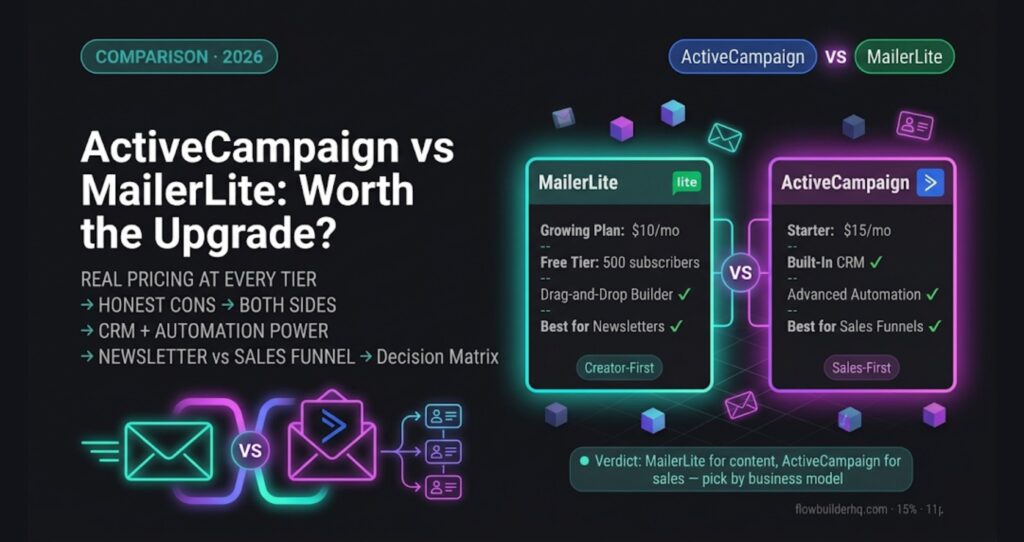
ActiveCampaign vs MailerLite for solopreneurs is the question every email-driven business hits when their list grows past basic broadcasting. You started on MailerLite free. It worked. Then you hit the ceiling — contacts, automations, or just the feeling that your email tool is holding your business back. Now you’re looking at ActiveCampaign and wondering if the price jump is actually justified.
Short answer: it depends on one thing. If email is just how you stay in touch with your list, MailerLite’s paid plan is probably enough. If email is how you run your business — qualifying leads, triggering workflows, scoring contacts, and feeding your CRM — ActiveCampaign earns its price tag fast.
Here’s the full breakdown of how these two tools compare for solopreneurs in 2026, with real numbers and no sugarcoating.
Who These Tools Are Actually Built For
MailerLite was designed for creators and small publishers who need clean newsletters, a simple drag-and-drop builder, and basic automation without a learning curve. It does that job well. The free plan is genuinely useful up to 500 subscribers, and the paid plans are priced for people who flinch at SaaS bills.
ActiveCampaign was built for sales-driven businesses. Even at the entry level, it’s closer to a CRM with email attached than an email tool with CRM bolted on. The automation engine is the product. Everything else — email, forms, landing pages — feeds into that engine.
That distinction matters more than any feature comparison table. The right tool depends on your business model, not your subscriber count.
Feature Comparison: What You Actually Get
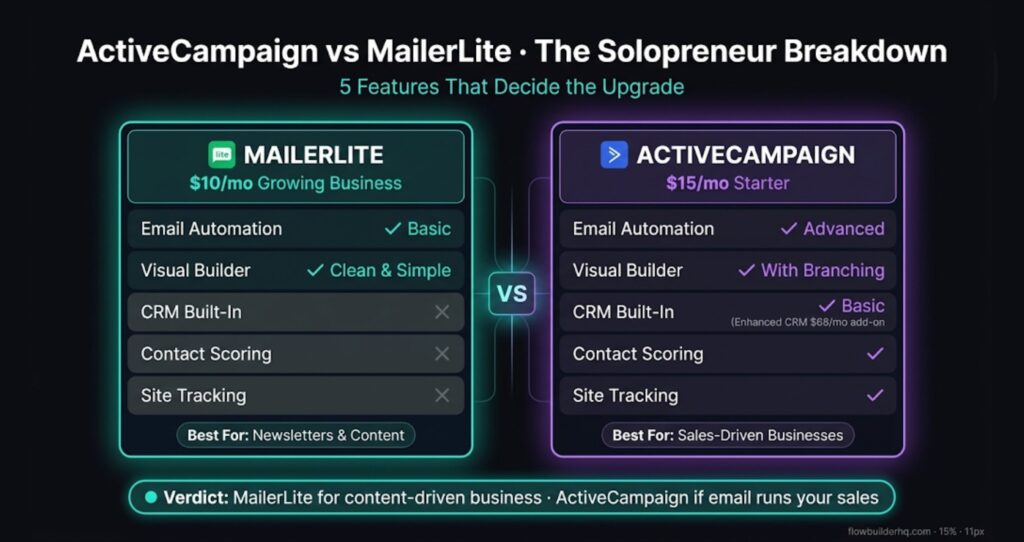
| Feature | MailerLite (Growing Plan) | ActiveCampaign (Starter) |
|---|---|---|
| Email automation | Yes — basic triggers and sequences | Yes — advanced branching, conditions, loops |
| Visual automation builder | Yes | Yes — significantly more powerful |
| CRM / deal pipelines | No | Yes — built in |
| Contact scoring | No | Yes |
| Site tracking | No | Yes |
| Conditional content in emails | Basic | Advanced |
| SMS marketing | No | Yes (add-on) |
| Landing pages | Yes | Yes |
| A/B testing | Yes | Yes |
| E-commerce integrations | Basic (Stripe, WooCommerce) | Deep (Shopify, WooCommerce, BigCommerce) |
| Native integrations | ~150+ | 970+ |
| Free plan | Yes — up to 1,000 subscribers | No |
MailerLite covers the basics well. But if you’ve ever wanted to say “when someone visits my pricing page twice and doesn’t buy, send them this sequence” — that lives in ActiveCampaign territory, not MailerLite’s.
ActiveCampaign vs MailerLite Pricing: The Real Math
This is where most comparisons get lazy. Let’s use a real scenario: 1,000 active contacts.
- MailerLite Free: $0 (up to 500 subscribers, 12,000 emails/month, MailerLite branding)
- MailerLite Growing Plan: Starts at $10/month for 500 subscribers (annual billing). At 1,000 subscribers, it’s approximately $15/month. Removes branding, adds unlimited emails, auto-resend, and dynamic emails.
- MailerLite Advanced Plan: Starts at $18/month (annual) or $20/month (monthly) for 500 subscribers. At 1,000 subscribers, it’s approximately $25/month. Adds custom HTML editor, AI writing assistant, unlimited users, and priority support.
(Note: MailerLite reduced the free tier from 1,000 to 500 subscribers in September 2025 — older articles may show the higher limit.)
- ActiveCampaign Starter: $15/month at 1,000 contacts (annual billing). Includes basic CRM functionality, email and marketing automation (limited to 5 actions per automation), and email sends up to 10x your contact count. Note: ActiveCampaign’s full “Enhanced CRM” pipeline features are a paid add-on starting at $68/month.
- ActiveCampaign Plus: $49/month at 1,000 contacts. Adds landing pages, lead scoring, Facebook Custom Audiences, and more automation triggers.
At 1,000 contacts, MailerLite Growing Business (~$15/month) and ActiveCampaign Starter ($15/month annual) are nearly identical in price. The gap widens as you scale. At 5,000 contacts, MailerLite Growing Business is around $39/month — ActiveCampaign Starter is around $69/month.
The honest math: If you’re choosing between them purely on price, MailerLite wins at every tier. ActiveCampaign only justifies the premium if you’re actually using the CRM, lead scoring, or site tracking features. Those features have to be generating revenue for you — otherwise you’re paying for a dashboard you don’t open.
Automation: Where ActiveCampaign Pulls Away
MailerLite’s automation builder is clean and gets the job done for linear sequences: someone subscribes, they get a welcome email, then a follow-up three days later. For a content creator or newsletter writer, that’s often all you need.
ActiveCampaign’s automation builder is a different animal. You can build workflows with multiple conditions, split paths based on contact behavior, loop contacts back through sequences, trigger automations from CRM deal stage changes, and stack automations on top of each other. The learning curve is real — expect a learning investment before it clicks — but once it does, you can build systems that would take dozens of Zaps or Make.com scenarios to replicate externally.
One specific thing MailerLite can’t do that solopreneurs running service businesses constantly want: trigger an automation when a contact visits a specific page on your site more than once. ActiveCampaign’s site tracking handles this natively. This alone is worth the upgrade if you have a services or consulting business with a pricing page.
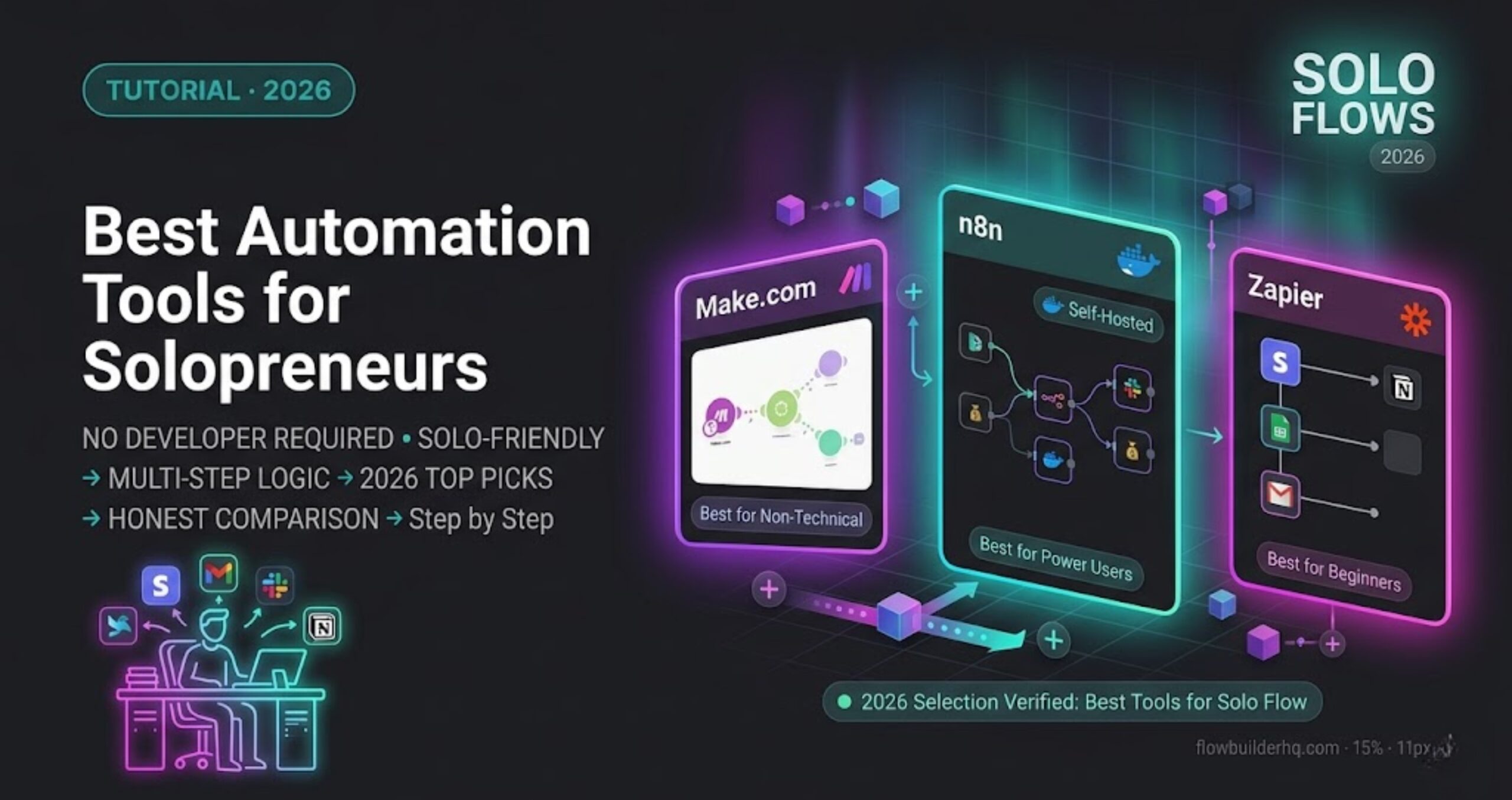
If you’re pairing either tool with an external automation platform, check out our breakdown of the best automation tools for solopreneurs in 2026 — the native power of ActiveCampaign means you need fewer external triggers to get the same result.
The CRM Question
MailerLite has no CRM. Full stop. It’s an email marketing platform, and it doesn’t pretend to be otherwise.
ActiveCampaign includes basic CRM functionality starting at the Starter plan, but the full Enhanced CRM with deal pipelines requires a $68/month add-on. Even with this, you’re consolidating tools that would otherwise require separate subscriptions. For solopreneurs doing any kind of sales — coaching, consulting, services, product demos — this matters. You can create deal pipelines, move contacts through stages manually or automatically, and trigger emails based on deal activity. It’s not Salesforce, but for a 1-5 person operation it covers a lot of ground.
The CRM is also where ActiveCampaign’s automation really shines for service businesses. When a deal moves to “Proposal Sent,” automatically start a 3-email follow-up sequence. When a deal closes, trigger an onboarding automation. When a deal goes cold after 14 days, assign yourself a task. These workflows save hours every week once you build them.
If MailerLite is where you’re landing on this, you’ll need a separate CRM tool — and then you’ll need to connect them, which adds both cost and complexity.
Deliverability: Does It Actually Matter Here?
Both tools have solid deliverability. In third-party testing through 2025-2026, both consistently land above 90% inbox rates across major providers, according to EmailToolTester’s deliverability benchmarks. This is not where you should make your decision. Any material difference is going to come down to your list hygiene and sending habits, not the platform.
Ease of Use: MailerLite Wins, Clearly
MailerLite is one of the cleanest email tools on the market. The interface is intuitive, the drag-and-drop editor is excellent, and you can build a campaign in 20 minutes on day one without reading any docs.
ActiveCampaign is not hard to use, but it has depth. The automation builder requires some orientation. The CRM has its own logic. The contact tagging and list structure can confuse people used to simpler tools. Plan for a proper onboarding session — ActiveCampaign’s own tutorial library is good, but you need to invest an afternoon.
If you’re already stretched thin and just need email to work without thinking about it, MailerLite’s lower friction is a real advantage.
Honest Cons: ActiveCampaign
- Price scales fast. At 10,000 contacts, you’re looking at $189/month on Plus. That’s a real line item for a solo operation.
- Complexity you might never use. If you’re sending newsletters and nothing else, you’re paying for an engine you’re keeping in park.
- The UI has aged in spots. Some parts of the interface — especially the older list management screens — feel like 2018. ActiveCampaign has been updating it, but it’s not fully consistent yet.
- Support can be slow. On the Starter plan, live chat isn’t always instant. Some users report 24-48 hour email responses during busy periods.
Honest Cons: MailerLite
- No CRM. If your business involves any active sales, you’re adding a separate tool and connecting them manually or via automation.
- Automation ceiling. Power users will hit the limits of what MailerLite can trigger and branch on. It’s not built for complex conditional logic.
- Account approval friction. MailerLite is known for occasionally holding new accounts for manual review, which can delay launches. This has improved, but it still happens.
- No lead scoring. You can tag and segment, but you can’t dynamically score contact engagement and trigger based on score thresholds.
Integration With Make.com and Other Automation Tools
Both tools connect to Make.com. But the connection means different things for each.
With MailerLite, you’ll likely use Make.com to compensate for things MailerLite can’t do natively — like moving contacts to different lists based on external events, pushing data from your booking tool, or syncing with a separate CRM. It’s a workaround layer.
With ActiveCampaign, Make.com becomes an amplifier rather than a patch. ActiveCampaign handles the email and CRM logic internally; Make.com handles the connections to tools outside that ecosystem. The result is cleaner, more maintainable automation stacks.
If you’re building automation seriously, read the full Make.com review to understand where it fits alongside your email platform — whether you pick MailerLite or ActiveCampaign.
You can also connect both tools to external AI workflows, which opens up personalization at scale that neither platform can do alone. For context on how that works in practice, see how solopreneurs are automating client onboarding with n8n.
Who Should Pick ActiveCampaign
- You sell services, coaching, or consulting and have an active sales process
- You want email behavior to automatically update a deal or trigger a follow-up
- You need site tracking to know which contacts are warming up
- You’re building sequences with conditional branches based on what contacts do (or don’t do)
- You want one tool handling email + CRM instead of two tools plus a connector
Who Should Stay on MailerLite
- You run a newsletter or content business where email is one-to-many broadcasting
- Your automation needs are linear: subscribe → sequence → done
- You’re under 500 subscribers and the free plan covers everything you need
- Budget is genuinely tight and you need to stay under $20/month
- You want minimal setup time and zero learning curve
The Verdict: ActiveCampaign vs MailerLite for Solopreneurs
For solopreneurs running service businesses, ActiveCampaign wins. The CRM, lead scoring, site tracking, and advanced automation aren’t extras — they’re the product. You’re not paying more for the same thing with a better interface. You’re paying for a different category of tool.
For creators, newsletter operators, and anyone whose business runs on content rather than active sales, MailerLite is legitimately excellent. The Growing plan at $13.50/month is one of the best value plays in email marketing right now. Don’t upgrade past it unless you have a specific reason.
The mistake most solopreneurs make is staying on MailerLite out of inertia after their business model shifts into active sales. If you’re following up on leads manually, managing proposals in a spreadsheet, and patching together automations with Zapier to compensate for what your email tool can’t do — that’s your signal. The ActiveCampaign switch pays for itself in the first month of actually using it.
Try ActiveCampaign free for 14 days — no credit card required.
Not sure which automation stack makes sense around either tool? Start with the best automation tools for solopreneurs in 2026 to map out the full picture before you commit to a platform.
Building this yourself? Get the workflow pack.
5 ready-to-import n8n workflows — lead capture, invoicing, content repurposing, onboarding, social posting. Free.