Writesonic Review for Solopreneurs: Does It Still Compete with ChatGPT and Claude?
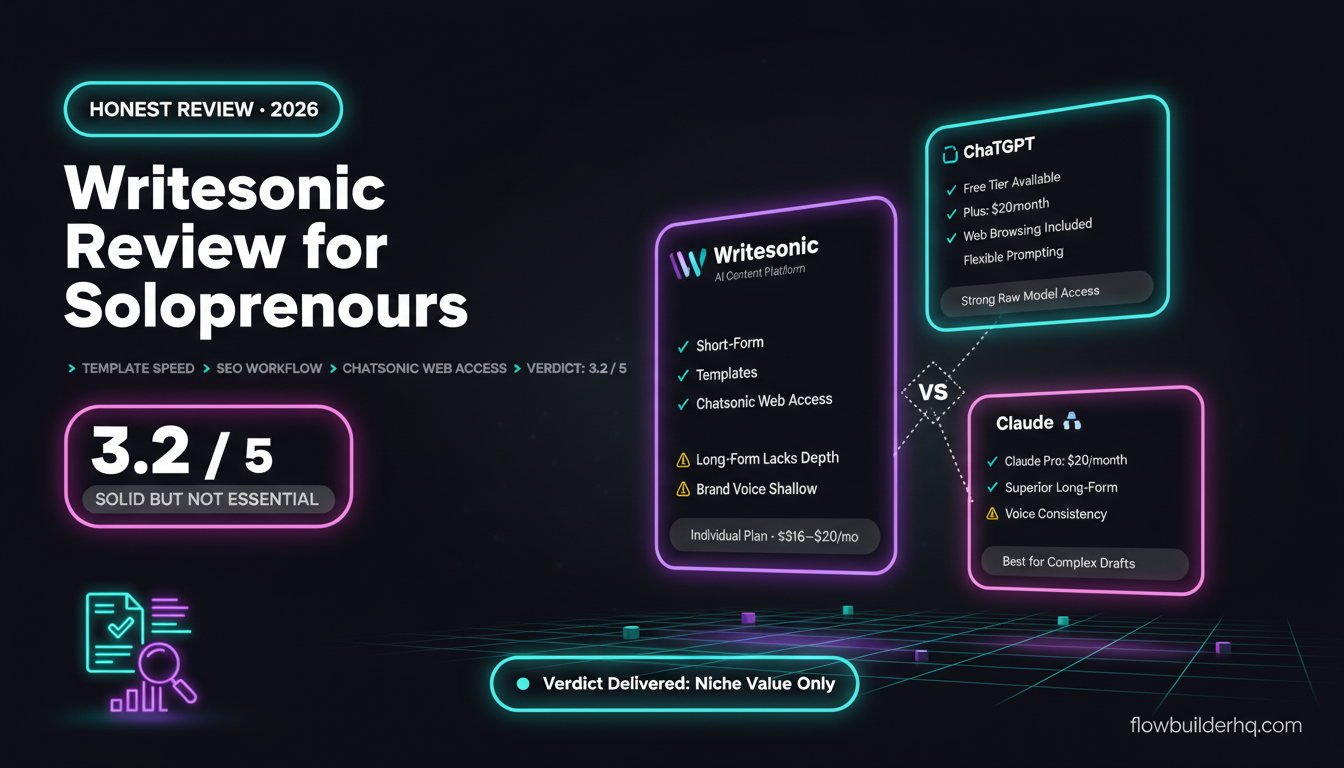
Verdict: 3.2 / 5 — Writesonic has real strengths for structured content output, but the value proposition gets shaky when free ChatGPT exists and Claude handles long-form drafts better at comparable price points. Worth a look for specific use cases. Not a clear winner for most solopreneurs.
This Writesonic review for solopreneurs covers the honest answer: is this tool still worth paying for in 2026, or has the rise of ChatGPT and Claude made it redundant? The short answer depends entirely on what you need it to do. The long answer is below.
What Writesonic Is (and What It’s Trying to Be)
Writesonic started as a template-driven AI writing tool — you picked a format (blog intro, ad copy, product description), filled in a few fields, and got output. That model worked in 2021 when GPT-3 access was expensive and hard to get.
It’s evolved significantly since then. Writesonic now includes Chatsonic (a ChatGPT-style chat interface with web browsing), an AI article writer, an SEO checker powered by its Surfer SEO partnership, brand voice settings, and a growing suite of marketing-specific templates. It’s less of a single tool and more of a content platform.
That ambition is both its strength and its problem. The platform tries to serve content marketers, agencies, ecommerce sellers, and solopreneurs simultaneously — and each audience gets a slightly watered-down version of what they actually need.
Writesonic Pricing in 2026
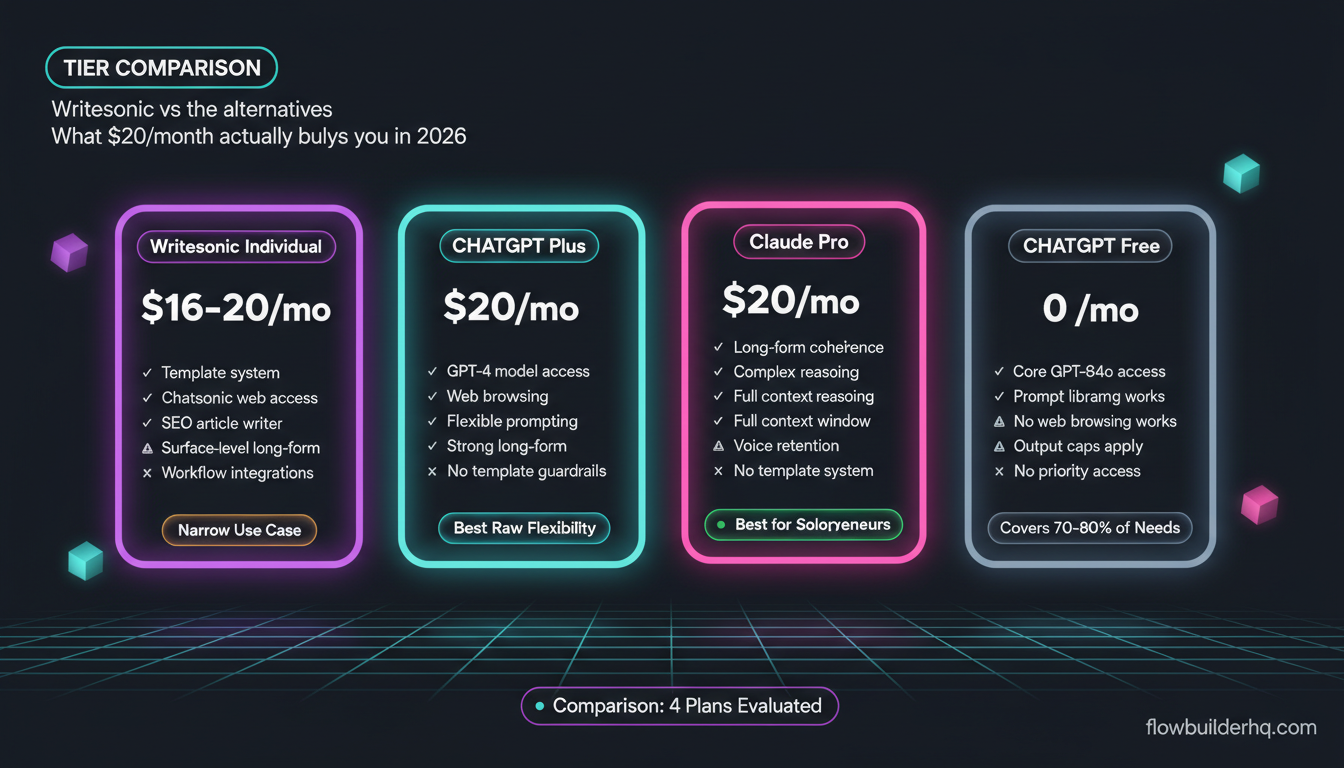
Writesonic’s pricing has changed multiple times. As of 2026, check their current pricing page directly since tiers and credit structures shift frequently. Generally, expect a free tier with limited word credits, an Individual plan in the $16–$20/month range, and higher tiers for teams and agencies. The free tier is genuinely usable for light testing — not just a bait-and-switch trial.
Compare that to the alternatives: ChatGPT free tier is still free, ChatGPT Plus runs $20/month, and Claude Pro also runs $20/month. For a solopreneur doing content work, that comparison matters a lot. You’re essentially deciding whether Writesonic’s structured templates and SEO features justify the cost when you could get raw model access elsewhere.
If you want a full breakdown of how AI writing tools stack up on price and output, the best AI writing tools for solopreneurs in 2026 post covers that with a wider comparison set.
Output Quality: What Writesonic Actually Produces
Blog Content and Long-Form Articles
The AI Article Writer is Writesonic’s flagship feature. You provide a topic, choose a tone, optionally add keywords, and it generates a full draft with headings and sections. The output is competent. It’s not embarrassing. For thin informational posts or product roundups, it saves real time.
The problem is the ceiling. Long-form output from Writesonic tends to stay surface-level. Introductions are generic. The tool doesn’t reason through a topic — it sequences information. That distinction matters if your content needs to differentiate, take a position, or reflect actual experience. Generic SEO content at scale: Writesonic delivers. Opinion pieces, brand voice-heavy content, or nuanced explainers: it struggles.
Claude handles the latter category significantly better. If you’re producing content where voice and reasoning matter, the ChatGPT vs Claude comparison is worth reading before committing to any paid writing tool.
Short-Form Copy: Ad Copy, CTAs, Product Descriptions
This is where Writesonic still earns its keep. The template system for short-form formats — Facebook ads, Google ad headlines, email subject lines, product descriptions — produces fast, usable output. The format constraints actually help here. When you’re generating 10 ad headline variations or 5 product descriptions for an Etsy store, the template approach is faster than prompting a general model from scratch.
For solopreneurs running paid ads or ecommerce, this is a legitimate time saver. For everyone else, it’s less compelling.
Chatsonic vs ChatGPT Free
Chatsonic is Writesonic’s chat interface. It includes real-time web access by default, which gives it an edge over the base ChatGPT free tier. You can ask it to research current events, pull in recent data, or check what competitors are doing right now.
But ChatGPT Plus already includes web browsing, and Claude’s output quality for reasoning and writing tasks is generally higher. Chatsonic’s web access is useful — but it’s not a differentiator that justifies a subscription on its own. If Chatsonic’s web browsing is the main draw for you, the Gemini Advanced vs ChatGPT Plus comparison puts all the real-time-access options side by side.
Writesonic Review for Solopreneurs: The Workflow Fit Problem
Most solopreneurs don’t just need words. They need words that fit into a system — content that gets published, repurposed, sent to clients, or fed into a funnel. Writesonic generates output but doesn’t connect to that downstream workflow natively. It has some integrations, but you’re mostly copying and pasting.
ChatGPT and Claude work well as thinking partners for the whole process — brief, draft, revise, repurpose — not just draft generation. That flexibility matters more than template speed when you’re a one-person operation wearing every hat.
If your content output is significant enough to need automation around it, something like automating content repurposing with Make.com will give you more leverage than switching writing tools.
The SEO Features: Genuinely Useful or Just a Checkbox?
Writesonic has a built-in SEO mode that integrates with Surfer SEO for on-page optimization scoring. If you’re already a Surfer SEO subscriber, this overlap is interesting. If you’re not, it’s a limited version of what Surfer’s own editor does.
The SEO article writer workflow — keyword input → outline → draft with NLP terms → Surfer score — is functional. It produces content that checks SEO boxes. Whether that content actually ranks depends on the quality of your keyword targeting and domain authority, not the tool.
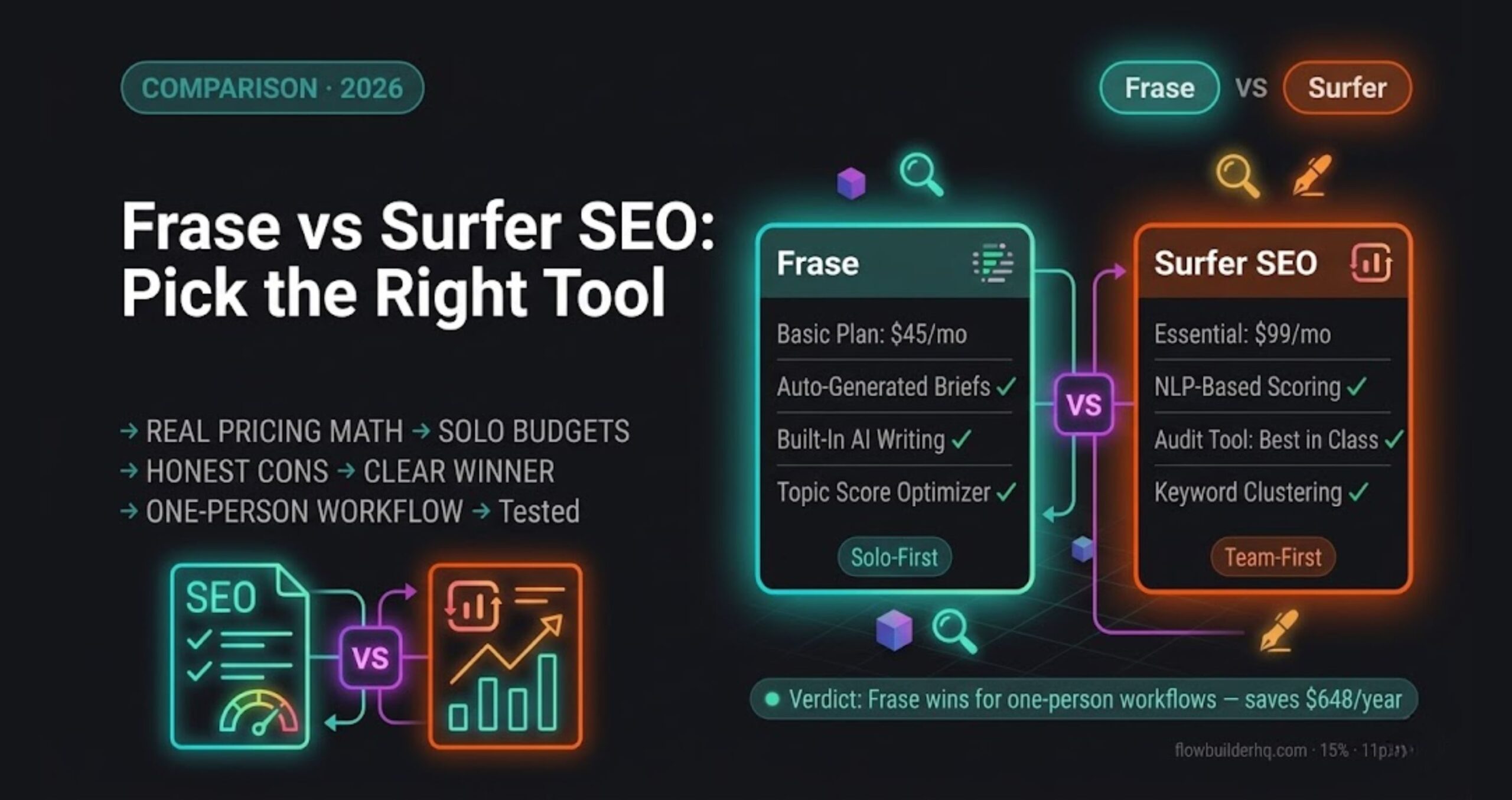
For solopreneurs who want a dedicated SEO content tool, the Frase review and the Frase vs Surfer SEO comparison are more targeted reads. Writesonic’s SEO features sit somewhere in between — better than nothing, not as deep as dedicated tools.
Where Writesonic Wins
- Short-form template speed. If you need ad copy variations, email subject lines, or product descriptions fast, the template system is genuinely quick.
- Built-in web access via Chatsonic. Useful for research-light tasks without opening a separate browser tab.
- Lower learning curve than raw API access. For non-technical solopreneurs who want AI writing help without prompting from scratch, the guided interface helps.
- All-in-one content platform feel. If you want one dashboard instead of toggling between tools, Writesonic at least attempts to centralize things.
The Honest Cons
- Long-form output lacks depth. Articles read as assembled, not reasoned. Fine for thin content; not fine for differentiated content.
- Pricing isn’t clearly better than ChatGPT Plus or Claude Pro. At $20/month, you get stronger raw models elsewhere. Writesonic’s value is in the template structure, not the model quality.
- Credit/word limits create friction. Depending on the plan, you’ll hit output caps mid-workflow. That’s annoying when you’re in a production session.
- The platform is bloated. Too many features competing for attention. The dashboard tries to show you everything at once, and the result is a cluttered UI that slows you down.
- Brand voice training is shallow. You can upload samples and set tone, but the voice doesn’t hold across a long draft the way fine-tuned prompting in Claude or GPT-4 does.
How It Compares to Copy.ai
Copy.ai is the closest direct competitor. Both started as template-based AI copy tools and both have expanded into longer-form territory. Copy.ai has leaned harder into workflow automation with its “workflows” feature — multi-step AI pipelines you can build without code. Writesonic has leaned harder into SEO content production.
Copy.ai’s Starter plan runs $49/month ($36/month annual). Writesonic’s individual plans are cheaper at current pricing. If short-form copy templates are your primary use case, Writesonic is the more affordable option. If you want AI-driven workflow automation, Copy.ai’s pipelines go further — though neither replaces a proper automation layer for your business. The Copy.ai review breaks down that tool’s strengths and weaknesses in full.
How It Compares to ChatGPT and Claude
This is the question every solopreneur considering Writesonic should answer honestly before subscribing.
ChatGPT (free) does most of what Writesonic’s templates do — you just write the prompt yourself instead of filling in a form. That’s a small skill gap, not a technical barrier. If you spend 30 minutes building a prompt library for your most common content tasks, free ChatGPT matches 70–80% of what Writesonic delivers.
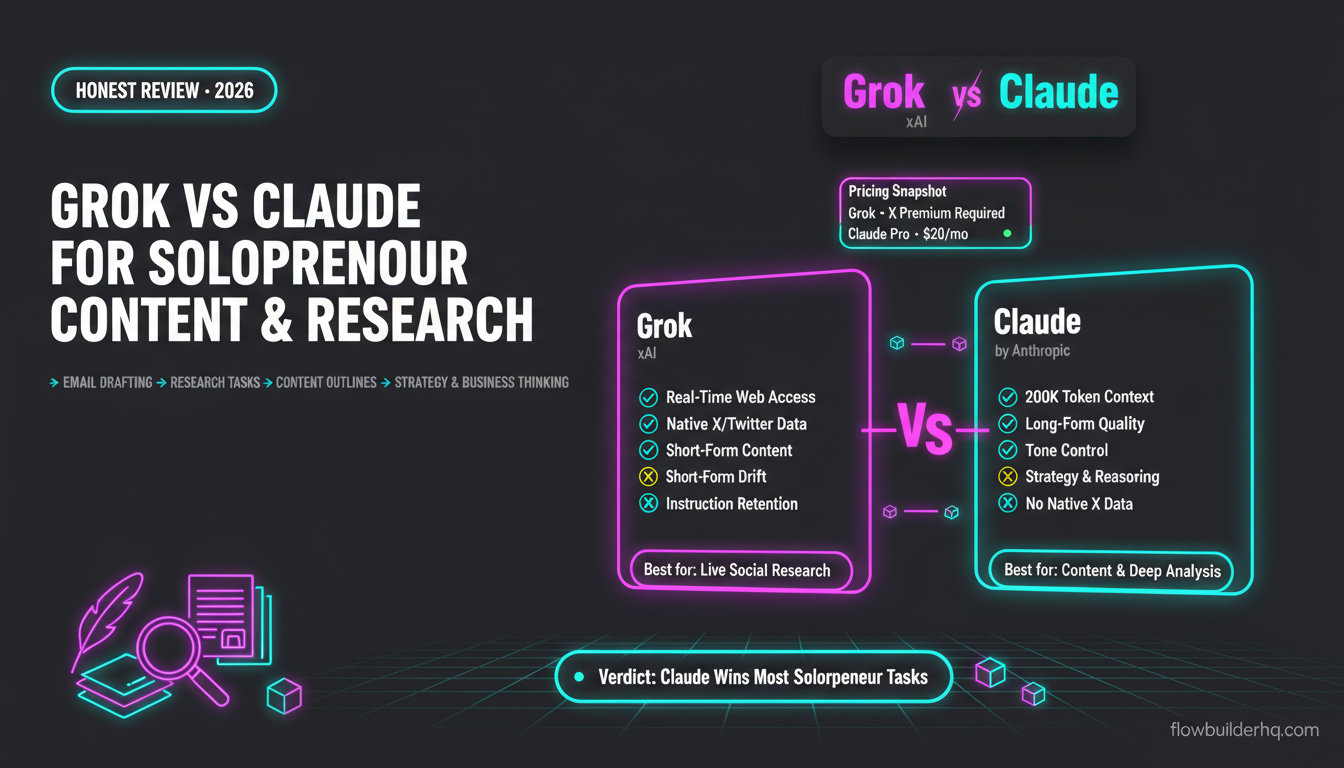
Claude Pro at $20/month produces longer, more coherent drafts than Writesonic, handles complex reasoning better, and maintains context across a full content session. For solopreneurs who write regularly, Claude is a stronger tool for most tasks. The Gemini Advanced vs Claude comparison gives more context on where Claude sits in the current AI writing landscape.
Writesonic sits in a middle zone: more structured than a blank chat interface, less powerful than the frontier models. That middle zone has real value for people who want guardrails and speed over flexibility and depth. Just be clear about which camp you’re in before paying.
For a broader look at where AI writing tools fit into a full solopreneur toolkit, the AI tools for solopreneur productivity in 2026 post gives a full picture of what’s actually worth paying for across categories.
Who Writesonic Is For
- Solopreneurs running ecommerce who need fast product description variations
- Marketers producing high-volume short-form ad copy who want template speed
- Content producers targeting SEO volume who want an integrated Surfer workflow
- Non-technical operators who find blank chat interfaces intimidating and want guided inputs
Who Should Skip It
- Solopreneurs who already subscribe to ChatGPT Plus or Claude Pro — there’s significant overlap and the incremental value is thin
- Anyone producing opinion-driven, voice-heavy content — raw model access with strong prompting beats Writesonic’s templates here
- Operators building AI into workflows — Writesonic doesn’t play well with automation layers. For that, explore what the Claude API or n8n can do instead.
- Budget-conscious solopreneurs — free ChatGPT covers more ground than most people realize before reaching for a paid tool
Final Verdict
Writesonic is a competent tool in a market that’s gotten brutally competitive. Three years ago, it stood out. Today, it’s one of several options that each do parts of the job well. The template system is genuinely fast. The SEO article workflow is functional. Chatsonic’s web access is useful. But none of it is clearly better than what you get from ChatGPT Plus or Claude Pro at the same price.
If you produce a high volume of structured short-form content — ads, product descriptions, email subject lines — Writesonic is worth a free trial. If your content needs are primarily long-form, research-heavy, or voice-specific, put that $20/month into Claude or ChatGPT Plus instead.
The tool earns a 3.2/5. Solid but not essential. The right choice for a narrow slice of solopreneur use cases, and a redundant spend for everyone else.
For a full picture of how the major AI writing tools rank against each other in 2026, the Jasper AI review and the complete AI writing tools comparison are worth reading alongside this one before you decide where to spend.
You can also check Writesonic’s official site for current pricing and to test the free tier directly — plans and credit structures change often enough that it’s worth verifying before subscribing.
Building this yourself? Get the workflow pack.
5 ready-to-import n8n workflows — lead capture, invoicing, content repurposing, onboarding, social posting. Free.